
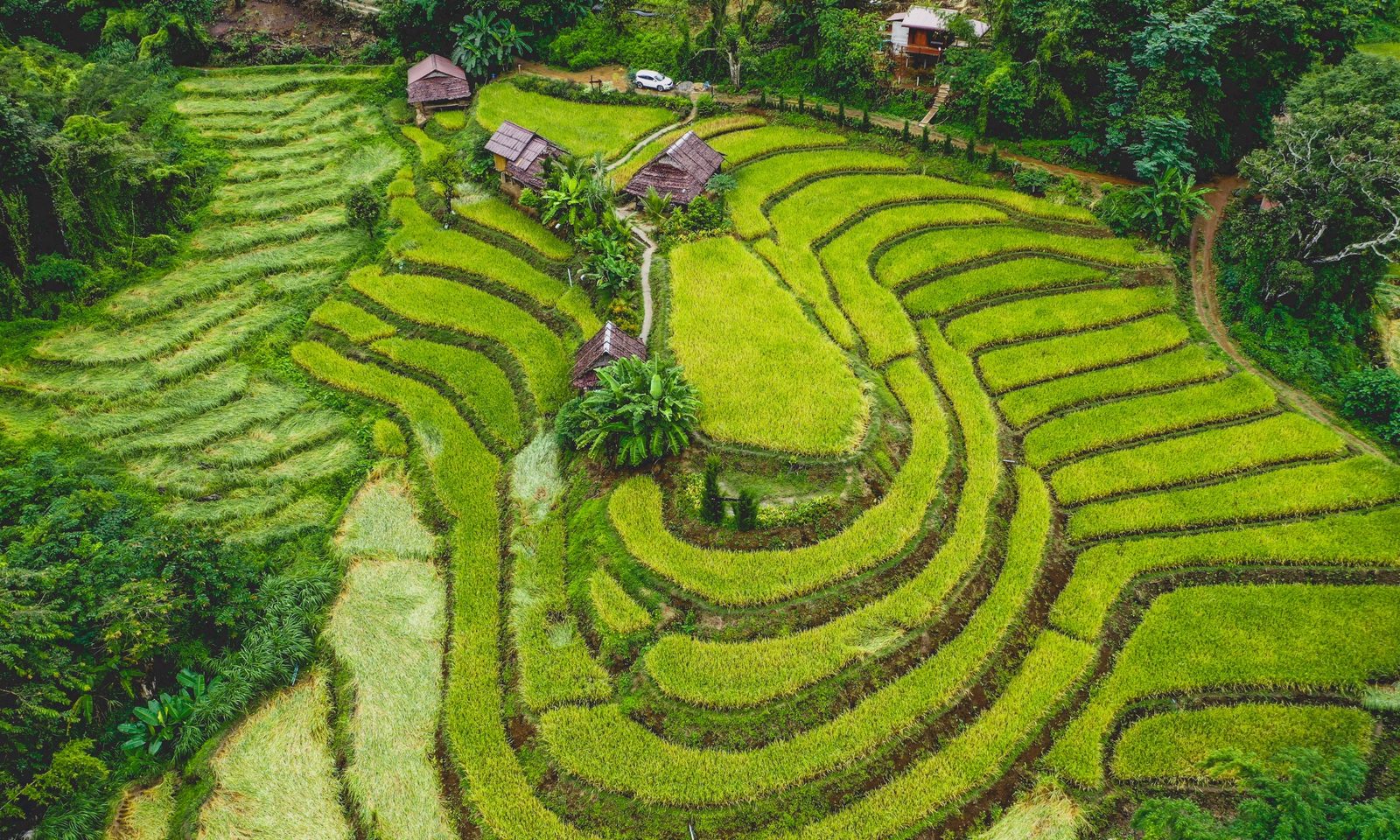
If you’re looking at land in Thailand for the first time, three words soon become familiar: Rai, Ngan, and Square Wah. They’re common on land listings and title deeds. If you’re used to acres or hectares, it can take a little practice to picture the area.
The first time someone told us a plot was “1-2-50,” Kris and I just nodded and pretended we understood. We didn’t. It took an embarrassingly long time and a lot of squinting at title deeds before I actually internalized what these numbers mean — and I’m Thai.
These customary units remain common for land plots. Condo-unit sizes and building floor areas are usually given in square meters (m²), so first check what the listing measures: the plot, the building, or a particular unit.
Thai Land Measurement at a Glance
Here’s the cheat sheet. Bookmark this table — it’s the one you’ll keep coming back to.
| Unit | Area (m²) |
|---|---|
| Square wah | 4 |
| Ngan | 400 |
| Rai | 1,600 |
In Thai: rai = ไร่, ngan = งาน, and square wah = ตารางวา (often abbreviated ตร.ว.). Approximate square-foot equivalents are 43 ft² per square wah, 4,306 ft² per ngan, and 17,222 ft² per rai.
The relationship between them:
- 1 Rai = 4 Ngan = 400 Square Wah = 1,600 sqm
- 1 Ngan = 100 Square Wah = 400 sqm
- 1 Square Wah = 4 sqm
1 rai is approximately 0.395 acres, so about 2.53 rai make an acre. It is exactly 0.16 hectares, or 6.25 rai per hectare.
What Is a Rai?
Rai (ไร่) is a customary Thai land-area unit used for everything from farms to residential plots. One rai is exactly 1,600 m²; the Industrial Estate Authority of Thailand uses this conversion in its land information.
The farming associations make the word memorable, but a rai is a fixed area today. It does not depend on the work a farmer can do or the shape of the plot.
How Big Is 1 Rai?
“1,600 square meters” doesn’t land (pun intended) until you can picture it:
- As a square: 40 meters by 40 meters — about 131 feet on each side. A plot can have a different shape and still cover one rai.
- Football (soccer) pitch: About 22% of a 105 × 68 m playing field (7,140 m²).
- Tennis courts: About 6.1 doubles-court rectangles by area, excluding run-off space and facilities.
- House plots: A 50–100 square wah plot is 200–400 m², or one-eighth to one-quarter rai. One rai gives you four times the area of a 100-square-wah plot.
Understanding Ngan and Square Wah
Ngan and square wah are useful when comparing smaller residential plots. Listings may give a single unit or combine all three.
Traditional units and metric units coexist. Land listings often use rai, ngan, and square wah; a project brochure may also give the site area in m². Condo-unit sizes typically use m². For example, Sansiri’s THE BASE Height Chiangmai brochure lists unit sizes in m² and square feet separately from the project’s land area. A building’s total floor area can span several stories and is not the same as the land beneath it.
Ngan (งาน) — The Quarter Rai
Ngan (งาน) literally means “work” in Thai. It’s the middle unit:
- 1 Ngan = 100 Square Wah = 400 sqm
- There are exactly 4 Ngan in 1 Rai
As a square: 20 meters by 20 meters (about 66 feet on each side).
A 1-ngan plot has 400 m² of land. That could allow space for a house, driveway, and garden, but the usable layout depends on the plot’s shape, access, and building requirements — the area alone does not tell you what fits.
Square Wah (ตารางวา) — The Building Block
Square wah is useful for describing small plots and the remainder in a three-part land measurement.
Wah (วา) is a traditional Thai length unit, now exactly 2 meters (about 6.56 feet). Thinking of an armspan can help you remember the idea, but a person’s actual reach is not a precise measure.
Square Wah is that length squared: 2m x 2m = 4 square meters (about 43 sq ft).
100 square wah make a ngan; 400 make a rai. For example, a house plot of 50–80 square wah covers 200–320 m² of land. A condo advertised as 32–40 m² describes the unit’s area, not a private plot of 8–10 square wah.
How to Read Thai Land Sizes (The X-X-X Format)
In Thailand, land area is written in a three-part format: Rai-Ngan-Square Wah. Something like 2-1-50 reads left to right, largest to smallest:
- 2 Rai
- 1 Ngan
- 50 Square Wah
To convert to square meters, multiply each part by its metric equivalent and add:
| Part | Value | Multiplier | Result |
|---|---|---|---|
| 2 Rai | 2 | × 1,600 sqm | 3,200 sqm |
| 1 Ngan | 1 | × 400 sqm | 400 sqm |
| 50 Sq Wah | 50 | × 4 sqm | 200 sqm |
| Total | 3,800 sqm |
You’ll see this format on title deeds, listings, and land office documents. A few more examples:
- 0-1-25 = 0 + 400 + 100 = 500 sqm (~0.12 acres).
- 0-3-50 = 0 + 1,200 + 200 = 1,400 sqm (~0.35 acres).
- 4-2-0 = 6,400 + 800 + 0 = 7,200 sqm (~1.78 acres).
- 15-0-0 = 24,000 sqm (~5.93 acres).
The same arithmetic works when square wah includes a decimal. For example, 2-2-99.5 = 3,200 + 800 + 398 = 4,398 m². A Lopburi government report on land-title deeds records exactly this fractional square-wah amount.
In a normalized three-part value, the ranges are 0 ≤ ngan < 4 and 0 ≤ square wah < 100. Fractions such as 99.5 square wah are valid; 100 square wah carries into 1 ngan, and 4 ngan into 1 rai. A listing that simply says “400 square wah” is also 1 rai — the single-unit amount does not have the same remainder limit.
Rai Calculator — Convert Thai Land Units
Return to the calculator to enter a single unit or the three parts from a listing. It converts the area without changing what the listing measures.
Quick Conversion Cheat Sheet
Thai to Metric:
| From | To | Multiply by |
|---|---|---|
| Square Wah | sqm | × 4 |
| Ngan | sqm | × 400 |
| Rai | sqm | × 1,600 |
Thai to Imperial:
| From | To | Multiply by |
|---|---|---|
| Square Wah | sq ft | × 43.06 |
| Rai | acres | × 0.395 |
| Rai | sq ft | × 17,222 |
Imperial / Metric to Thai:
| From | To | Multiply by |
|---|---|---|
| Acres | Rai | × 2.53 |
| Hectares | Rai | × 6.25 |
| sqm | Square Wah | × 0.25 |
Common Questions About Thai Land Measurement
How much is 1 rai in acres?
1 Rai is approximately 0.395 acres. To put it another way, about 2.53 Rai make 1 acre.
How big is a wah in Thailand?
A Wah (วา) is a unit of length equal to 2 meters (about 6.56 feet). A Square Wah (ตารางวา) is a unit of area: 2m × 2m = 4 square meters (about 43 square feet). Land listings may shorten “square wah” to “wah”; check that the figure is an area.
What is the unit of measurement for land in Thailand?
Land plots are commonly described in Rai (ไร่), Ngan (งาน), and Square Wah (ตารางวา). 1 Rai = 4 Ngan = 400 Square Wah = 1,600 square meters. Condo-unit and building floor areas are typically stated in m².
How many square meters is 1 ngan?
1 Ngan equals 400 square meters (about 4,306 square feet). A Ngan is one-quarter of a Rai and equals 100 Square Wah.
How many rai is 1 acre?
1 acre equals approximately 2.53 Rai. Multiply your acreage by 2.53 to get the Rai equivalent.
What does 1-2-50 mean on a Thai land listing?
The three numbers represent Rai-Ngan-Square Wah, Thailand’s standard notation for land area. 1-2-50 means 1 Rai, 2 Ngan, and 50 Square Wah. To calculate: (1 × 1,600) + (2 × 400) + (50 × 4) = 2,600 square meters (about 0.64 acres).
Is Thailand’s land measurement system the same as metric?
These are customary units with exact metric equivalents: 1 Rai is 1,600 m², 1 Ngan is 400 m², and 1 Square Wah is 4 m². You can convert between them and metric units; both appear in Thai property information.
Once you get used to thinking in Rai, Ngan, and Square Wah, it becomes second nature. I still catch myself converting back to acres for American family, but honestly, after years here, “half a rai” just means something — I can picture it, I know what fits on it, and I know roughly what it costs.
The system isn’t complicated — it’s just unfamiliar. Remember the clean relationships: 100 square wah make a ngan, and four ngan make a rai. Once those feel familiar, a listing becomes much easier to picture.
Save this page and return to the calculator when an agent sends a listing such as 0-3-75. It tells you the area; the plot plan tells you how that space is arranged.
Planning a move? Our Chiang Mai Cost of Living guide gives you a full breakdown of what life here actually costs.