
If you’re looking at land in Thailand for the first time, you’re going to run into three words almost immediately: Rai, Ngan, and Wah. They’ll be on every listing, every title deed, and in every conversation with an agent — and if you’re used to acres or hectares, your brain is going to short-circuit.
The first time someone told us a plot was “1-2-50,” Kris and I just nodded and pretended we understood. We didn’t. It took an embarrassingly long time and a lot of squinting at title deeds before I actually internalized what these numbers mean — and I’m Thai.
Thailand has its own land measurement system that predates the metric system, and it’s still the standard for everything property-related. The good news: it’s simple once someone explains it properly, and that’s what this guide is for.
Thai Land Measurement at a Glance
Here’s the cheat sheet. Bookmark this table — it’s the one you’ll keep coming back to.
| Unit | Thai Script | Metric Equivalent | For Americans | Real-World Size |
|---|---|---|---|---|
| Square Wah (ตารางวา) | ตร.ว. | 4 sqm | 43 sq ft | A king-size bed |
| Ngan (งาน) | งาน | 400 sqm | 4,306 sq ft | A generous house lot |
| Rai (ไร่) | ไร่ | 1,600 sqm | 17,222 sq ft | A quarter of a soccer field |
The relationship between them:
- 1 Rai = 4 Ngan = 400 Square Wah = 1,600 sqm
- 1 Ngan = 100 Square Wah = 400 sqm
- 1 Square Wah = 4 sqm
For Americans, 1 Rai is roughly 0.4 acres — so 2.5 rai gets you about an acre. For Brits and Aussies, it’s about 0.16 hectares, so 6.25 rai to a hectare.
What Is a Rai?
Rai (ไร่) is Thailand’s primary unit of land measurement. The word literally means “field” in Thai — because the unit has roots in Thailand’s agricultural past.
Historical note: The traditional story is that 1 rai represented the amount of land a farmer could plow in a day using a water buffalo.
How Big Is 1 Rai?
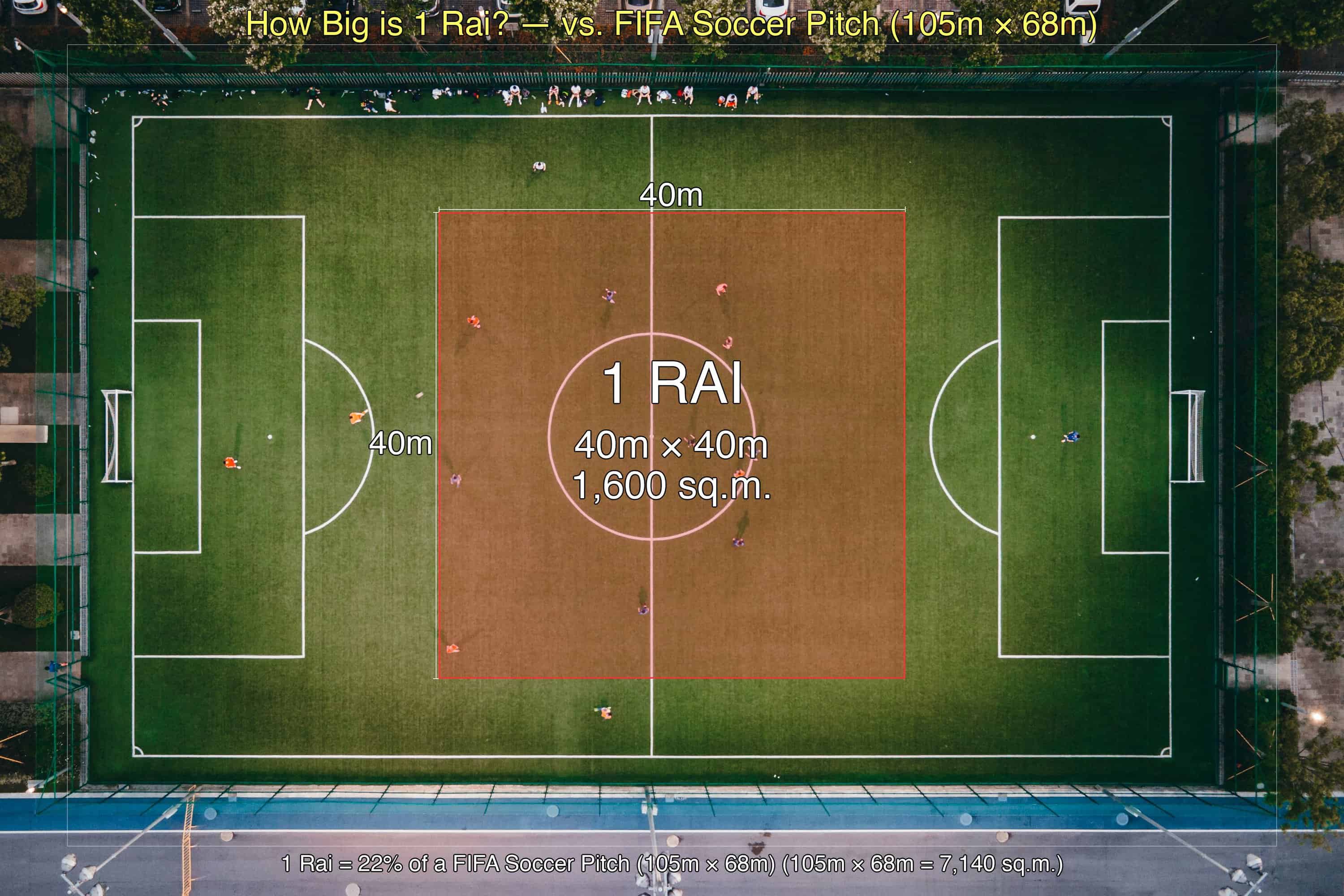
“1,600 square meters” doesn’t land (pun intended) until you can picture it:
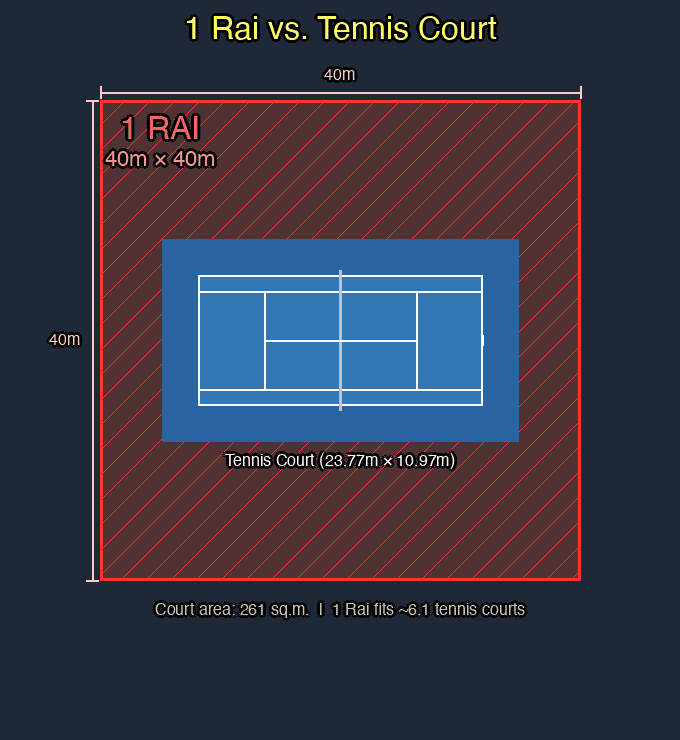
- As a square: 40 meters by 40 meters — about 131 feet on each side
- Soccer field: Roughly a quarter of a FIFA pitch (7,140 sqm). Mentally divide the field into four — each quarter is about 1 rai
- Tennis courts: About 6 tennis courts side by side
- American football: About 35% of a football field — everything between the goal line and the 35-yard line
- In Chiang Mai: Most mooban house lots are 50-100 square wah — that’s one-quarter rai at most. A full rai in a mooban would be unusual and generous — room for a pool, garden, multiple buildings
Understanding Ngan and Square Wah
The Rai gets all the attention, but Ngan and Square Wah are the units that matter when you’re looking at a specific plot — especially for residential land.
Historical note: Despite adopting the metric system over a century ago, for land — and only land — these traditional units persisted. Nobody here talks about land in square meters or hectares. It’s always Rai, Ngan, and Wah. Even official government documents use these units.
Ngan (งาน) — The Quarter Rai
Ngan (งาน) literally means “work” in Thai. It’s the middle unit:
- 1 Ngan = 100 Square Wah = 400 sqm
- There are exactly 4 Ngan in 1 Rai
As a square: 20 meters by 20 meters (about 66 feet on each side).
In practice, 1 ngan is a very comfortable house lot. A typical Bangkok townhouse plot is only 16-20 square wah (64-80 sqm). A suburban Chiang Mai mooban plot runs 50-100 square wah (200-400 sqm). So 1 ngan is a generous suburban plot with room to spare — house, driveway, and a real garden.
Square Wah (ตารางวา) — The Building Block
This is the smallest unit you’ll regularly encounter, and it has a beautifully human origin.
Wah (วา) is a traditional Thai unit of length — the distance between an adult’s outstretched fingertips, roughly 2 meters (about 6.5 feet). Stretch your arms wide and you’ve just measured 1 Wah.
Square Wah is that length squared: 2m x 2m = 4 square meters (about 43 sq ft).
It’s the base unit everything builds on. 100 make a Ngan. 400 make a Rai. For smaller residential plots — townhouses, condos, suburban lots — prices and sizes are quoted in square wah. A small Chiang Mai condo might be 8-10 square wah (32-40 sqm). A mooban house plot, 50-80 square wah (200-320 sqm).
How to Read Thai Land Sizes (The X-X-X Format)
In Thailand, land area is written in a three-part format: Rai-Ngan-Square Wah. Something like 2-1-50 reads left to right, largest to smallest:
- 2 Rai
- 1 Ngan
- 50 Square Wah
To convert to square meters, multiply each part by its metric equivalent and add:
| Part | Value | Multiplier | Result |
|---|---|---|---|
| 2 Rai | 2 | × 1,600 sqm | 3,200 sqm |
| 1 Ngan | 1 | × 400 sqm | 400 sqm |
| 50 Sq Wah | 50 | × 4 sqm | 200 sqm |
| Total | 3,800 sqm |
You’ll see this format on title deeds, listings, and land office documents. A few more examples:
- 0-1-25 = 0 + 400 + 100 = 500 sqm (~0.12 acres). Comfortable house plot in a Chiang Mai mooban.
- 0-3-50 = 0 + 1,200 + 200 = 1,400 sqm (~0.35 acres). Generous lot — room for a pool and guest house.
- 4-2-0 = 6,400 + 800 + 0 = 7,200 sqm (~1.78 acres). Small farm or resort plot.
- 15-0-0 = 24,000 sqm (~5.93 acres). Orchard, rice farm, or boutique development.
Historical note: Things got precise in the late 1800s when King Rama V standardized the measurement system, and in 1923, when Thailand adopted the metric system, the Rai was formally defined as exactly 1,600 square meters. That definition is used on every title deed, in every land office, and in every transaction in the country today.
The Ngan value is always 0-3 (because 4 Ngan rolls over to 1 Rai). The Square Wah value is always 0-99 (because 100 rolls over to 1 Ngan). If you see a listing that says “400 square wah” without the X-X-X format, that’s 1 Rai exactly — some agents skip the formatting.
Rai Calculator — Convert Thai Land Units
Plug in your numbers using the calculator above and it does the math instantly. Whether you’re converting from a title deed, sizing up a listing, or comparing to something familiar.
Quick Conversion Cheat Sheet
Thai to Metric:
| From | To | Multiply by |
|---|---|---|
| Square Wah | sqm | × 4 |
| Ngan | sqm | × 400 |
| Rai | sqm | × 1,600 |
Thai to Imperial:
| From | To | Multiply by |
|---|---|---|
| Square Wah | sq ft | × 43.06 |
| Rai | acres | × 0.395 |
| Rai | sq ft | × 17,222 |
Imperial / Metric to Thai:
| From | To | Multiply by |
|---|---|---|
| Acres | Rai | × 2.53 |
| Hectares | Rai | × 6.25 |
| sqm | Square Wah | × 0.25 |
Common conversions people search for:
- 1 Rai = 1,600 sqm = 0.395 acres = 0.16 hectares = 17,222 sq ft
- 1 Acre = 2.53 Rai
- 1 Hectare = 6.25 Rai
- 5 Rai = 8,000 sqm = ~2 acres
- 10 Rai = 16,000 sqm = ~4 acres
Common Questions About Thai Land Measurement
How much is 1 rai in acres?
1 Rai is approximately 0.395 acres. To put it another way, 2.53 Rai equals 1 acre.
How big is a wah in Thailand?
A Wah (วา) is a traditional Thai unit of length equal to 2 meters (about 6.5 feet) — the distance between an adult’s outstretched fingertips. A Square Wah (ตารางวา) is 2m x 2m = 4 square meters (about 43 square feet).
What is the unit of measurement for land in Thailand?
Thailand uses three customary units: Rai (ไร่), Ngan (งาน), and Square Wah (ตารางวา). They’ve been in continuous use for centuries and were officially standardized in 1923. 1 Rai = 4 Ngan = 400 Square Wah = 1,600 square meters.
How many square meters is 1 ngan?
1 Ngan equals 400 square meters (about 4,306 square feet). A Ngan is one-quarter of a Rai and equals 100 Square Wah.
How many rai is 1 acre?
1 acre equals approximately 2.53 Rai. Multiply your acreage by 2.53 to get the Rai equivalent.
What does 1-2-50 mean on a Thai land listing?
The three numbers represent Rai-Ngan-Square Wah, Thailand’s standard notation for land area. 1-2-50 means 1 Rai, 2 Ngan, and 50 Square Wah. To calculate: (1 × 1,600) + (2 × 400) + (50 × 4) = 2,600 square meters (about 0.64 acres).
Is Thailand’s land measurement system the same as metric?
No. While Thailand adopted the metric system in 1923, land is still measured using the traditional Rai-Ngan-Square Wah system. These units are defined in terms of square meters (1 Rai = exactly 1,600 sqm), but they’re used instead of metric units in all property contexts.
Once you get used to thinking in Rai, Ngan, and Square Wah, it becomes second nature. I still catch myself converting back to acres for American family, but honestly, after years here, “half a rai” just means something — I can picture it, I know what fits on it, and I know roughly what it costs.
The system isn’t complicated — it’s just unfamiliar. And Thailand’s traditional units are honestly more intuitive than acres once you’ve internalized them. A Wah is your armspan. A Rai is a field. The math is clean and decimal. What’s not to like?
Save this page and the calculator above — you’ll need it when that agent sends you a listing at 0-3-75 and you want to know whether it’ll fit the pool you’ve been dreaming about.
Planning a move? Our Chiang Mai Cost of Living guide gives you a full breakdown of what life here actually costs.